
Why AI is more than a technology story
What different AI scenarios mean for institutional portfolios, property and real assets. Key message The economic consequences of AI extend far beyond technology equities and could be decisive for the valuation of virtually the entire institutional portfolio.
Many investors view AI as primarily a technology story. Their attention therefore focuses on chip manufacturers, software companies and the winners of today’s AI race. For institutional portfolios, however, the significance of AI extends much further.
Investors in property, infrastructure, corporate bonds or private markets are also exposed to the economic consequences of AI. Artificial intelligence may affect productivity, economic growth, inflation and interest rates, and could therefore become a key driver of valuations across virtually all asset classes.
The relevant question for investors is therefore not only whether AI will live up to high expectations. It is how their portfolio will perform if the economic effects of AI turn out to be substantially different from what markets currently expect.
Four possible AI regimes
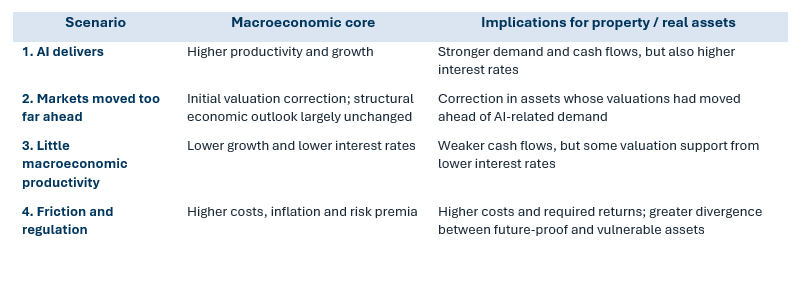
We distinguish four scenarios. In the first, AI lives up to the high expectations and produces a genuine structural acceleration in productivity. In the second, financial markets have mainly moved too far ahead of the eventual benefits: valuations correct, while the structural economic outlook remains largely unchanged. In the third, AI is widely adopted, but its contribution to macroeconomic productivity remains limited. In the fourth, the technology works, but social, geopolitical, infrastructure and institutional frictions cause some of the economic benefits to be lost.
For institutional portfolios, these scenarios produce materially different outcomes. This applies not only to equities, but also to fixed-income and credit investments, infrastructure, property and private markets. AI is therefore not merely a sector theme, but also an issue for ALM and strategic asset allocation.
From technology to bricks and mortar
Property clearly illustrates why AI should not be considered solely as a technology scenario. If AI genuinely produces a strong productivity boost, economic activity will increase. This could support demand for logistics property, high-quality office space, housing and, above all, digital infrastructure. Data centres are the most visible link between AI and real assets, but the broader economic effects extend much further.
There is a countervailing force. Stronger structural growth may also push interest rates higher. For property, this creates tension between stronger rental fundamentals and capital value drivers on the one hand, and higher discount rates on the other. Even in the most positive scenario, it is not immediately obvious whether AI is “good for property.”
The reverse may occur if AI proves operationally useful but generates little additional macroeconomic productivity. Additional demand for property would then be more limited and structural economic growth lower. At the same time, interest rates could also be lower. Weaker cash flows would then be partly offset by lower financing costs and discount rates.
This distinction is particularly important for long-term investors. It is not the direction of AI adoption alone, but the combination of growth, interest rates, inflation and risk premia that determines the ultimate investment impact.
Not every disappointment is the same
A financial-market correction is not the same as a structural failure of AI. If investors have priced in too much of AI’s future economic benefits, a sharp valuation correction could occur without materially changing the structural economic outlook. This would primarily affect assets whose valuations had moved far ahead of that expected growth. After the correction, however, the underlying long-term outlook could remain largely intact.
This is fundamentally different from a world in which AI persistently delivers little productivity growth. In that case, not only valuations but also structural cash-flow and return expectations would change. For property investors, this distinction is essential: a correction in an expensively valued data-centre segment is a different issue from structurally lower demand for office or logistics space.
AI works, but friction increases
Perhaps the most challenging scenario is not one in which AI fails. AI could be technologically successful while its social and economic costs rise. Consider bottlenecks in energy and infrastructure, geopolitical fragmentation, cyber and governance risks, and tighter regulation. If higher inflation and interest rates coincide with higher risk premia, the result would be a particularly unfavourable combination for real assets.
This could further widen the gap between winners and losers. Access to electricity and grid capacity would become more valuable. Energy-efficient, modern buildings could gain an advantage over properties requiring substantial investment. Location would also acquire an additional dimension: not only economic growth and demographics would matter, but also infrastructure and the institutional regime.
Three insights for institutional investors
- AI exposure extends beyond technology equities. The same assumptions about productivity and growth feed through into fixed-income and credit investments, infrastructure, property and private markets. As a result, the portfolio may be more dependent on the same AI-related economic assumptions than a sector classification would suggest.
- Growth and interest rates can work in opposite directions. A positive AI outcome could strengthen property cash flows while also raising the discount rate. The reverse could occur if productivity disappoints.
- Selectivity becomes more important. The impact will not be uniform. Sector, region, individual asset quality, access to energy and the regulatory regime could further widen differences in return and risk.
From scenario analysis to robustness
For institutional investors, the relevant question is therefore how robust the portfolio is if the AI future develops differently from what is currently reflected in market prices. Scenario analysis reveals where the same economic assumptions recur across different asset classes and where actual diversification may be more limited than it first appears.
AI is not an isolated technology theme, but a macroeconomic scenario with implications for the entire portfolio.
A joint publication by Almazara and Triple A – Risk Finance
-

-
More information or a conversation with us?
Please contact Ridzert van der Zee

Call me back
© 2026 AAA Riskfinance. All rights reserved.